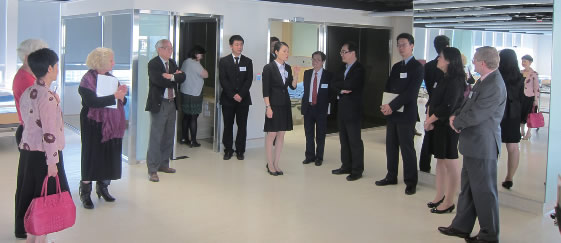
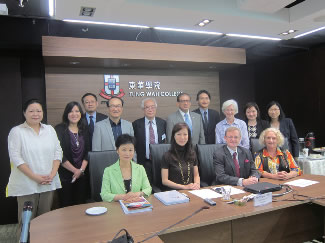
The HKCAAVQ provides a wide range of academic accreditation
services to operators. Our academic accreditation services cover
programmes offered by post-secondary institutions at postgraduate,
degree and sub-degree levels. We also offer accreditation services
for non-local learning programmes (NLP) registered or exempted from
registration under the Non-local Higher and Professional Courses
(Regulation) Ordinance (Cap 493), and conduct Institutional Reviews
(IR) for institutions seeking registration under the Post Secondary
Colleges Ordinance (Cap 320) for degree-awarding status.
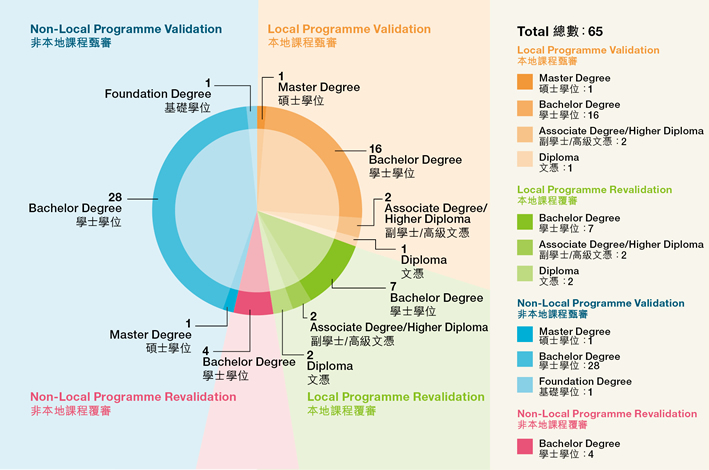
In 2013/14, the HKCAAVQ conducted Programme Validation (PV) for
a total of 20 programmes and Revalidation for 11 programmes, with
the participation of 12 operators. Besides the traditional programmes
in Computer, Finance, Hospitality, Languages and Nursing, we also
accredited programmes in less conventional fields such as Cantonese
Opera and Business Intelligence at Qualifications Framework (QF)
level 5.
In the year under review, we conducted two Programme Area
Accreditation (PAA) exercises for an institution seeking to develop
and operate learning programme(s) within an approved scope of a
programme area at the specified QF level; and processed requests
from nine operators for substantial changes to 24 programmes. We
also conducted an IR exercise for an institution seeking registration
under Cap 320 for degree-awarding status.
The NLP accreditation service quality assures programmes offered
in Hong Kong leading to awards of non-local institutions. An
NLP accredited by the HKCAAVQ enjoys similar status to locally-accredited
programmes, and its qualification can be recognised
under the QF and placed on the Qualifications Register (QR).
During the reporting year, the HKCAAVQ conducted IE for seven
partnerships, PV for a total of 30 NLPs and Revalidation for four
NLPs, with the participation of seven local operators and 14 overseas
partners. In addition, we processed requests for substantial changes
to 46 programmes involving seven local operators and 13 overseas
partners.
Breakdown of Academic Programmes Validated or Revalidated (1 April 2013 – 31 March 2014)
Enhancement of Academic Accreditation Services
Last year, the HKCAAVQ continued its efforts to enhance its
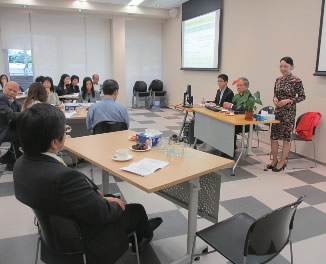
accreditation service. In April 2013, we organised a focus group
meeting with operators to share our proposed revisions to the
guidelines and the new templates developed for NLP accreditation.
Following the feedback received in the focus group meeting, the
refined NLP guidelines and the associated tools were published
on our website in July 2013. In addition, to better define the scope
of substantial change and enhance the efficiency of assessing
substantial changes, revised guidelines on substantial change to
accreditation status were published in the same period.
The HKCAAVQ strives to facilitate operators to undertake
accreditation. We organised briefings for operators to help them
better understand our accreditation criteria and processes. We also
offered tailor-made workshops to enable operators to prepare self-contained
accreditation documents and evaluate their own readiness
for undertaking accreditation.
To facilitate mutual understanding, we regularly have experience
sharing sessions with operators. To promote the use of QF credit, we
organised a sharing session with an operator in April 2013 to share
their practical experience on the use of QF credit. In March 2014,
we also invited an operator to share with us their views on some
authentic cases in relation to assignment of QF credit. These fruitful
exchanges deepened our understanding of the assignment of credits
in different institutions.
Review of the Four-stage Quality Assurance Process
The HKCAAVQ employs the Four-Stage Quality Assurance Process
(the Process) to accredit providers and their learning programmes
under the QF. The four stages are Initial Evaluation (IE), Programme
Validation (PV), Programme Area Accreditation (PAA) and Periodic
Review (PR).
Following the 2011 review, and consultation with stakeholders in
2012, the Council approved the following refinements to the Process
and its implementation progressively from 1 June 2013:
(i) Highlighting the learner-centred philosophy to guide implementation
(ii) Renaming Stage 2 from Programme Validation (PV) to Learning
Programme Accreditation (LPA) to align with international
practice
(iii) Formalising the combined exercise of Stage 1 Initial Evaluation (IE) and Stage 2 LPA as a standard route while keeping a stand
alone Stage 1 or Stage 2 as an option for operators
(iv) Formalising the enabling approach via the establishment of a
Facilitating Phase in Stage 1 and Stage 2
(v) Refining the eligibility criteria for proceeding to Stage 3
Programme Area Accreditation (PAA)
(vi) Adding to and aligning the PAA criteria
(vii) Establishing a Standing Panel on PAA Scope
(viii) Standardising validity periods for Stages 2-4
(ix) Refining QF level-linked accreditation status (Initial Evaluation,
Programme Area Accreditation, Periodic Review)
(x) Introducing annual reporting and regular monitoring via a central
repository
(xi) Refining PAA scope
During the year, we conducted a pre-test on the Facilitating Phase
to seek comments from operators on the proposed work models
and their associated processes. Operators were also invited to test
run the facilitating models in a pilot study. Apart from the Facilitating
Phase, the HKCAAVQ established a Standing Panel on PAA Scope
to facilitate the processing of PAA case review and better define the
PAA scope.
Assessment of Non-local Courses
The HKCAAVQ is appointed by the Registrar of Non-local Higher
and Professional Education Courses to provide professional advice
as to whether a particular non-local course delivered in Hong
Kong leading to the award of a non-local academic qualification or
professional qualification meets the registration criteria as stipulated
in Cap 493. We also advise the Registrar whether a registered non-local
course continues to meet the registration criteria through annual
assessments.
In the reporting year, the HKCAAVQ continued to work collaboratively
with the Non-local Courses Registry to revise the form for annual
return and develop a form for course changes in order to improve the
efficiency of the assessment service.
Breakdown of new applications for non-local course assessment (1 April 2013 – 31 March 2014)
by discipline of studying
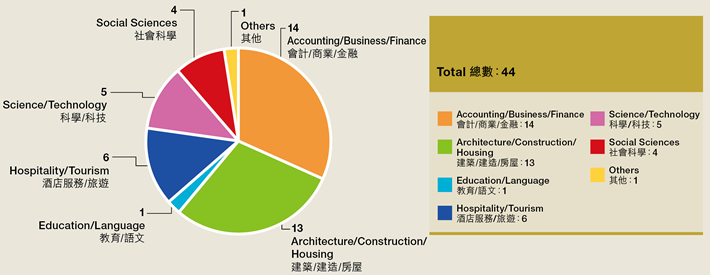
Breakdown of new applications for non-local course assessment (1 April 2013 – 31 March 2014)
by geographic origin
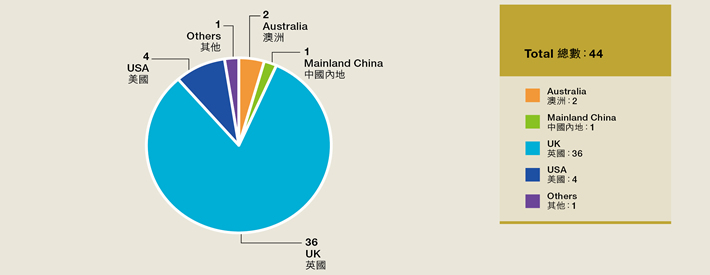
Breakdown of new applications for non-local course assessment (1 April 2013 – 31 March 2014)
by level of study
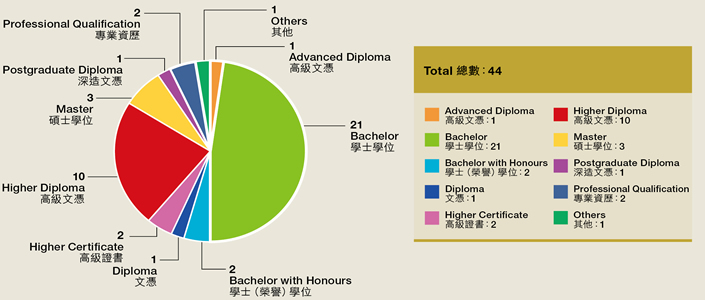
Assessment of CEF Courses
Since the inception of the Continuing Education Fund (CEF)
in June 2002, the HKCAAVQ has been commissioned by the
Government to provide advisory services in regard to the quality
assurance of the CEF courses. The HKCAAVQ works closely
with the Labour and Welfare Bureau (LWB) and the Office of the
Continuing Education Fund through regular tripartite meetings,
advises the Government on the suitability of courses to be
included in the list of reimbursable courses under the CEF, and
assesses proposed amendments to existing CEF courses. The
HKCAAVQ also conducts surprise audit visits to ascertain whether
the CEF courses are operated in compliance with the approved
conditions determined by the LWB.
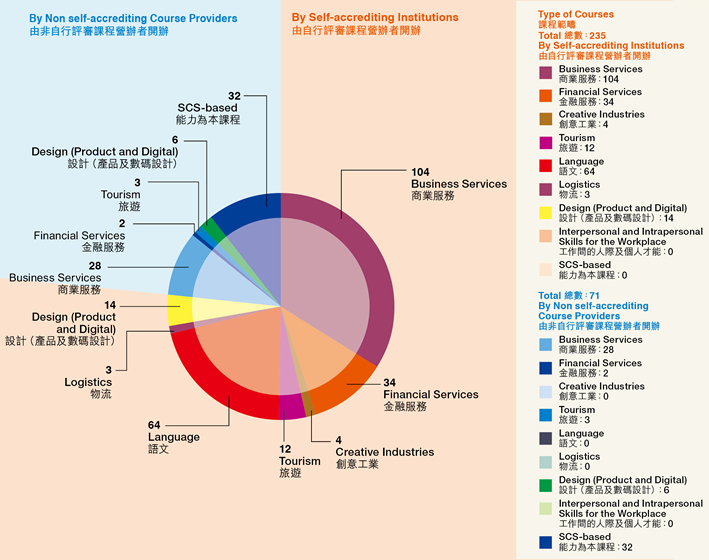
In the reporting period, the HKCAAVQ has conducted 85 surprise
audit visits and assessed 1,201 applications, which included
306 new applications and 844 applications for amendments to
registered CEF reimbursable courses.
Breakdown of the new applications for assessment of CEF reimbursable courses (1 April 2013 – 31 March 2014)

Professional Development Initiatives
To prepare the HKCAAVQ for new responsibilities in the future and
enhance the professional knowledge of our staff, we invited overseas
and local subject specialists to conduct workshops and seminars
on a wide range of themes such as “quality audit and accreditation”,
“effective questioning techniques” and “balancing costs and quality”.
We also invited professional bodies and licensing authorities to speak
on accreditation-related topics and share with us their experience in
accreditation. These exposures have advanced the expertise of our
staff and extended our local and international networks.
Looking Forward
With the increase in internationalisation of higher education, the
HKCAAVQ will continue to explore opportunities to collaborate with
institutions and other quality assurance agencies in different parts of
the world. Further, the HKCAAVQ will evaluate its quality assurance
practices against the International Network for Quality Assurance
Agencies in Higher Education (INQAAHE) Guidelines of Good
Practice for QA Agency. The HKCAAVQ will continue to consolidate
its knowledge and experience in academic accreditation and work
closely with stakeholders to further enhance its services.
Copyright © 2014 Hong Kong Council for Accreditation of Academic and Vocational Quali�cations (HKCAAVQ). All rights reserved. No part of this publication may be
reproduced, stored in a retrieval system, or transmitted, in any form or by any means, electronic, mechanical, photocopying, recording or otherwise, without the prior written
permission of the HKCAAVQ.