Vocational accreditation has been a new and increasingly important activity of the HKCAAVQ since the launch of the Qualifications Framework (QF), as one important function of the QF is to provide links between quality assured qualifications in the academic, vocational and continuing education sectors, in order to help foster lifelong learning.
Division of Vocational Accreditation
Collective Approach for Vocational Accreditation Services
The vocational and skills sectors have placed increasing emphasis on the value of the QF in enhancing the quality of both vocational courses and, more generally, the pool of available human resources in the sector. This has resulted in a high demand for vocational accreditation services under the Four-Stage Quality Assurance Process. The HKCAAVQ has noted the interest of the sector's course providers in a prompt accreditation service and the ability to meet the needs of vocational and skills-based courses — the majority of which are of short duration. Based on experiences gained in the pilot studies conducted for three industries in the 2007/08 reporting year, the HKCAAVQ has developed a collective approach to provide accreditation services to course providers seeking Initial Evaluation and Programme Validation at Stages 1 and 2 of the Four-Stage Quality Assurance Process. This collective approach has facilitated the HKCAAVQ in handling large-scale accreditation requests in an efficient and cost effective manner without compromising standards. In the reporting year, the Division of Vocational Accreditation completed Initial Evaluation exercises for 10 providers and conducted Programme Validation exercises for 116 programmes. In addition, accreditation activities were conducted in the context of Programme Area Accreditation for one institution, and a total of 18 programme areas were reviewed under the Periodic Review process.
ITAC Activities
The HKCAAVQ continues to be represented in the 12 existing Industry Training Advisory Committees (ITAC) formed under the QF by the Education Bureau (EDB). In addition to having direct dialogue with ITAC members pertaining to the HKCAAVQ's role as the Accreditation Authority and QR (Qualifications Register) Authority under the QF, major contributions are also made relating to the development and moderation of the Specification of Competency Standards (SCS) for relevant industries. With their SCSs in place, future accreditation of study programmes of the respective industries can include the consideration of these programmes as SCS-based.
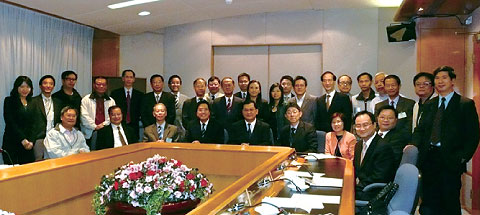
Chinese catering is one of the 12 industries that have
formed an Industry Training Advisory Committee
Review of Courses Run under the SUS and MDS
A 3-year cycle of confirmation reviews started in July 2008 for all course providers under the Skills Upgrading Scheme (SUS) and the Manpower Development Scheme (MDS, formerly known as the Employees Retraining Scheme). The purpose of these reviews is to ensure that all courses uploaded onto the QR through the sampling approach continue to meet the QF standards. These reviews are conducted by a group panel through a paper exercise and, where necessary, through on-site visits. During the year, confirmation reviews were completed for 56 MDS courses within the Chinese Medicine and Retailing categories, and 57 SUS courses within the Medical Care, Elderly Care, and Fashion Product & Textile industries. Confirmation review for another 143 courses has also commenced, and is expected to be completed by October 2009.
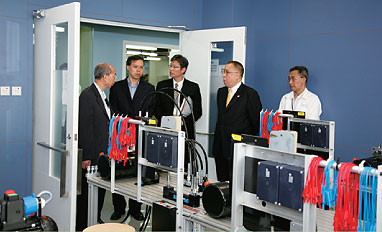
Vocational accreditation professionals of the HKCAAVQ attended meetings of
the Industry Training Advisory Committees to keep abreast of the industries' development
Quality Assurance of ApL Courses
The HKCAAVQ continues to be commissioned by the EDB to evaluate the learning outcomes and standards of the Applied Learning (ApL) courses developed for the secondary school sector. Eleven on-site peer reviews were conducted on the delivery aspects of these courses and recommendations were made to the EDB with the aim of facilitating continual improvement of the ApL courses. Moreover, the HKCAAVQ continues to be represented at the Curriculum Development Council Committee on Applied Learning formed by the EDB to develop the policy on the quality assurance framework for ApL courses under the new secondary school structure.
Networking with the Vocational Sector
The HKCAAVQ values the input and feedback of all stakeholders of our established vocational accreditation services and on new endeavours initiated since the launch of the QF. Secretariat staff have regular formal and informal exchanges with ITAC members and sector specialists to keep abreast of developments in manpower planning and the training requirements of relevant trades and industries. This ensures that accreditation services provided best fit the requirements of each sector. For providers planning or undergoing the accreditation activities, close communication has been maintained to enhance their understanding of the relevant accreditation principles and practices.
Looking Forward
Vocational accreditation is a growing 'business' for the HKCAAVQ and its success largely depends on a thorough understanding of the vocational and skills sectors of all accreditation requirements. To this end, the HKCAAVQ will step up efforts to encourage the relevant industries to adopt vocational accreditation standards within their specific fields. Consistent with the HKCAAVQ's ethos of facilitation and empowerment, we will introduce additional tools for course providers to help with their understanding of the accreditation criteria and standards, and assist them in conducting self-evaluation of their readiness to undergo accreditation.
The collective approach to vocational accreditation has been well received by the various industry sectors and the HKCAAVQ will continue to review the approach with the aim of making the accreditation framework more efficient and cost effective. Good communication channels and networks have already been developed with the industries concerned and efforts in this regard will continue to be made. Various new communication tools, such as enhanced website, will also be adopted to provide interested parties with accurate, up-to-date and readily accessible information on vocational accreditation.
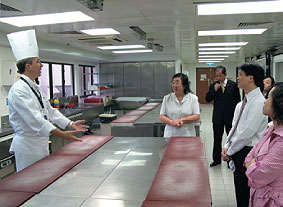
Site visit helps panel members understand more about the capability of
the accredited party in offering quality learning programmes